


In some respects the mid 1990’s were the golden age of route development in southwestern Utah. It seemed like everywhere we looked there were cliffs that just begged for the caress of a chalk covered hand. It seemed like every drive down a random dirt road would become a frustrating experience as there simply wasn't enough time, money, or energy to develop all of the crags that a short drive would reveal. The title of the first local guidebook summed it up nicely “ Too much rock not enough life."
Although the inevitable process of governmental designation of national monuments, wilderness areas, and conservation areas was well underway, (and would eventually have a huge impact on what and where we could climb) we were blissfully ignorant of that process at the time. In every direction that we looked laid climbing opportunities Few climbers want to spend their precious free time with the heavy labor that sport route development demands. Cleaning dirt out of pockets, removing choss, drilling holes and hammering bolts seems a far less appealing use of a weekend than just climbing on sunny solid stone, and it is. Many people climb for years without it ever crossing their mind where all those bolts came from and how they got in there in the first place. If the position of a particular bolt raises itself in their attention it is generally because it isn't where they think it should be. Or the pockets are a little to dirty for their tastes, or the rock isn't as solid or cleaned as they are used to . Many a first assentionists name is taken in vain. Yet without the pioneers who were willing to bear the brunt of this thankless labor we would have few of the opportunities that we now enjoy.
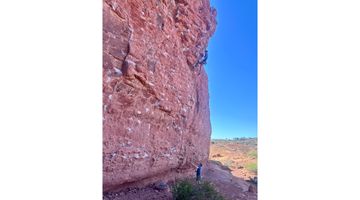
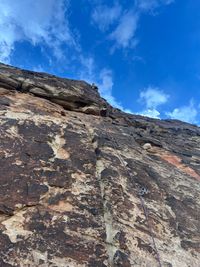
In 1995 there were less than 7 climbers living in St. George willing to take on the vastness of opportunity that lay scattered around the region. Mostly we looked for easily accessed cliffs with a density of route potential that offered quick access to the top of the cliff , and ideally the bottom. Chuckawalla, Black Rocks and the Green Valley Gap are prime examples, and even the VRG offers approach times under 10 minutes. As the easy to develop cliffs began to be filled in we inevitably looked further afield. In 1996 Michal Nad told me about a wall off of a gravel road that was a backway connection between Dammeron Valley and Gunlock. I had driven the road soon after arriving in St. George in 1992 but at the time I was more interested in traditional climbing, and didn't even notice the 200+ foot wall that faced the road. Michal described the wall as “pretty good” which given his European background and regard for quality rock, raised my interest.
Standing at the base of a huge featured wall that has never been climbed is a frustrating contradiction of emotions. Your mind is enchanted with the limitless possibilities but your spirit is crushed with the cost and scope of labor involved. Over the course of the last 30+ years I have learned to first focus on the obvious and ignore the subtle. Route developers refer to this as picking the plums. Choosing the most obvious and stunning route to begin on and then taking them one at a time is really the only viable option. Along the way your eyes will adjust to the subtleties of the wall and new routes will reveal themselves as you learn to read the secrets of this particular stone. It is a process that takes patience and a marathon mentality.
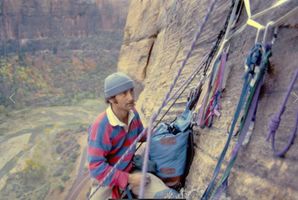
Yet in 1996 I hadn’t reached this level of developmental maturity, and I plunged into each new wall like a famished dog at a bowl of kibble. Ian Horn was a consummate climbing partner. Enthusiastic, energetic, available, and willing to tolerate my tirades, misanthropy and delusions of grandeur, Ian was always eager to head out into the unknown and look at profitless locations in the endless search for new cliffs. The one fatal flaw in Ian's demeanor was an inability to talk me out of stupid ideas, and while there have been many of these over the years, bolting 5 multi-pitch routes on the Prophesy wall in a single day ranks quite high on the all time list.
I honestly don't remember why five routes, or what inspired the sense of urgency, but at the time we were developing Veyo Pools, Welcome Springs, and Shinobe and funding for bolts and hangers was stretching my limited budget. Being a climbing bum has its advantages, and the frugality caused by lack of unlimited funding results in a level of creativity seldom seen outside of the third world. In 1996 each 1/2” bolt hanger combination cost me about $2.50 per lead bolt and $3.50 per anchor bolt. This was a manageable expense for Chuckawalla wall, but the Prophesy wall was another matter entirely, and we needed another option.
The soft nature of desert sandstone presents a host of issues in bolting. Sandstone's inherent weakness, and susceptibility to water infiltration and the subsequent degradation of the hole are major factors in considering bolts, sizes, positions ect… Glue in bolts are one solution to many of these problems. I had previously tested a host of glue-in bolts at cougar cliffs with a 120lb bucket of cement and 30’ of static rope with good success. 4” long pieces of threaded rod withstood multiple factor 2 falls with no discernible effect. Each time we threw the bucket off, the forces that we created would have snapped a healthy pelvis in two, as evidenced by several tweaked and broken carabineers on the bucket. The rod was bomber, and were a fraction of the cost of the Rawl bolts which made them a perfect solution for the Prophesy wall.
Ian and I had picked out 5 routes, installed anchors, fixed ropes, and done some initial cleaning of death blocks. Next we stood in Ace hardware for an hour spinning nuts down 5 foot long pieces of 3/8ths diameter threaded rod, which we then cut into 4 inch long pieces with their bolt cutter. Putting a hanger under the nut prior to putting the entire thing into a glue filled hole had the added advantage of eliminating the possibility of theft of the hangers due to the bolt cutter deforming the threads when we cut them. It seemed a simple and elegant solution to a daunting task, what could possibly go wrong?
The plan was for me to jumar the first fixed rope and drill the hole, clean it out and fill it full of glue, leaving the insertion of the actual bolt/hanger combination to Ian, who would only begin to jumar once I got to the top, and started down the next route with the same task, drill, clean and fill. Both our previous testing and the instructions on the glue gave us about a 45 minute set up time on the glue which we figured was more than enough to make the system work.
I think in retrospect that we accounted neither for the amount of time that it would take me to jumar, drill, blow out and fill 200 feet of holes, nor the fact that we had forgot the hammer in the truck down at the parking area. As Ian ran down the hill and back up again I was not about to let a little bad planning get in the way of equipping 5 multi pitch routes in a single day, and so I stubbornly began rappelling down the next route drilling and filling.
The first indications that our brilliant plan had a wrinkle or two was the swearing and hammering that was coming from high on the wall out of sight and around the corner. It seemed that the afternoon sun coming onto the wall was significantly lowering the time that the glue remained in a liquid state and the threaded rod was becoming significantly more difficult to insert into the holes. The word “bitch” was mentioned numerous times and with so many different connotations and nuances that I was impressed at Ians linguistic flexibility.
Stubbornness too often gets a bad rap as a personality trait, when applied to a goal or aspiration it is considered a beneficial attribute… until it isn't. As I stubbornly rappelled down what was eventually to become The Visionaries, drilling, cleaning, and filling, Ian began rappelling and found the glue I had left in my wake was completely solid in the holes offering no possibility of getting the bolts in. At that point we both realized that my grand plan had failed and beyond 3 bolted pitches of one route, we had only managed to equip the second with some glue filled holes. We departed in shame.
We returned the next morning and climbed the bolted route naming it Sticky Revelations, as it represented a sticky revelation of how not to develop a virgin cliff. The Visionaries was eventually bolted and climbed. The name intended in my mind that one person's “Vision” is another person's “Delusion”.
The holes with glue dribbling out are still visible near the current bolts.